Most coupon pages test a travel code once. Then they hide it behind a "verified daily" badge that never changes. We do the opposite. Every code we publish passes a four-layer check: region, customer type, booking category, and feed freshness. Every entry shows the date we last ran it at a live checkout. SimplyCodes' own Glass Box page says 40-60% of public-web codes are dead, restricted, or fake. One failed search wastes about 10 minutes. This is how we verify travel codes, and how we keep that waste near zero.
How we verify a travel promo code (the 4-layer method)
We verify a travel promo code in four layers: region (does it fire from a US connection or only in Asia), customer type (a new account versus a returning one), booking category (flights, hotels, eSIM, tours, or transfers), and freshness (from a Travelpayouts partner feed, not a scraper). Every code we publish carries a test date and a verdict.
Two people touch every code before it ships. A verifier types it into a real checkout and records what the cart did. A reviewer checks the source and the terms, then signs off — or sends it back. Neither step is a scrape. A big coupon site cannot hand-test 622,000 store pages, so it leans on bots. We cover the roughly 100-300 travel brands in the Travelpayouts catalog by hand. This two-person pass is how we verify travel codes before one goes live.
| Layer | What it catches | How we test it |
|---|---|---|
| 1 — Region | A code that fires in one country and dies in the next | Run it from a US connection and against the code's target place |
| 2 — Customer type | New-account-only codes that fail for repeat buyers | Test a fresh account and an older, logged-in one side by side |
| 3 — Booking category | Codes that mean one thing for flights, another for eSIM | Apply at each category's real checkout, where the code field differs |
| 4 — Freshness | Expired or fake codes dressed up as live | Source from Travelpayouts feeds with brand-issued expiry dates |
Layer 1 — by region: why a code that works in the US fails in Asia
In the region layer we catch codes that fire in one market and fail in another. Every code gets tested from a US connection and against its target country, and a region verdict records two things: whether the discount applied and whether the product actually works where you go.
Region breaks a travel code first, so we test it first. One string saves money in one country and does nothing in the next. Brands scope deals to a market. A Viator shopper said it on Reddit: "The first one worked when we booked Colombia, but it didn't work once we tried to book Asia." Another asked, "Not working for Tromso, Norway?" Same code, new country, dead.
We run each code twice: once from a US connection, once against the place the code targets. eSIM makes the point sharpest. A working code still leaves a dead line if the plan rides a weak local network. So a region verdict records two things: did the discount apply, and does the product work where you go?
Layer 2 — by customer type: new vs existing, and how we test both
The customer-type layer catches new-account-only codes that fail for repeat buyers. We test every code on a clean account and on an aged, logged-in one, then label it: new users only, works for existing accounts, or referral credit instead of a stackable discount.
Most travel codes are new-account levers, so we test as two shoppers. A returning buyer wrote: "Used WELCOMEVIATOR on my first ever booking. It knocked off about 8%. Friend tried it on an older account and it didn't work, so likely first time only." That one line is the whole layer.
The lockout is built on purpose. A developer described the merchant side: "Create a database table with coupons which are tied to a user and hold a flag whether they have been used already." Once that flag flips, the code is spent for that account. Stacking hits the same wall. Airalo support told a shopper the code "can't be combined with our referral program... you can use one discount at a time." We test every code on a clean account and on an aged one. Then we label it: new users only, works for existing accounts, or referral credit instead. The repeat-customer levers that survive live in our existing-user promo code guide.
Layer 3 — by booking category: flights vs hotels vs eSIM vs transfers
"Works" means something different in each category, so we test at each real checkout. On flights, a code can cut the fare while a booking fee eats the saving. That is why our CheapOair review compares the total after fees, not the sticker discount. On hotels, the "discount" is often a member price, not a code field. On eSIM, most codes are a first-order percent capped at a few dollars. On tours and transfers, they are usually flat amounts tied to a region.
How you apply the code changes too. A Viator user spelled it out: "the link won't work on the app, so it needs to be done on the web browser... click Price breakdown to show the Promo Code box." A code that works on the web and fails in the app is not dead. It is a category rule. We write it down instead of stamping a blanket "verified." These category rules — first-order caps, member-only rates, non-stacking limits — are the same shorthand our glossary of deal terms spells out in plain English.
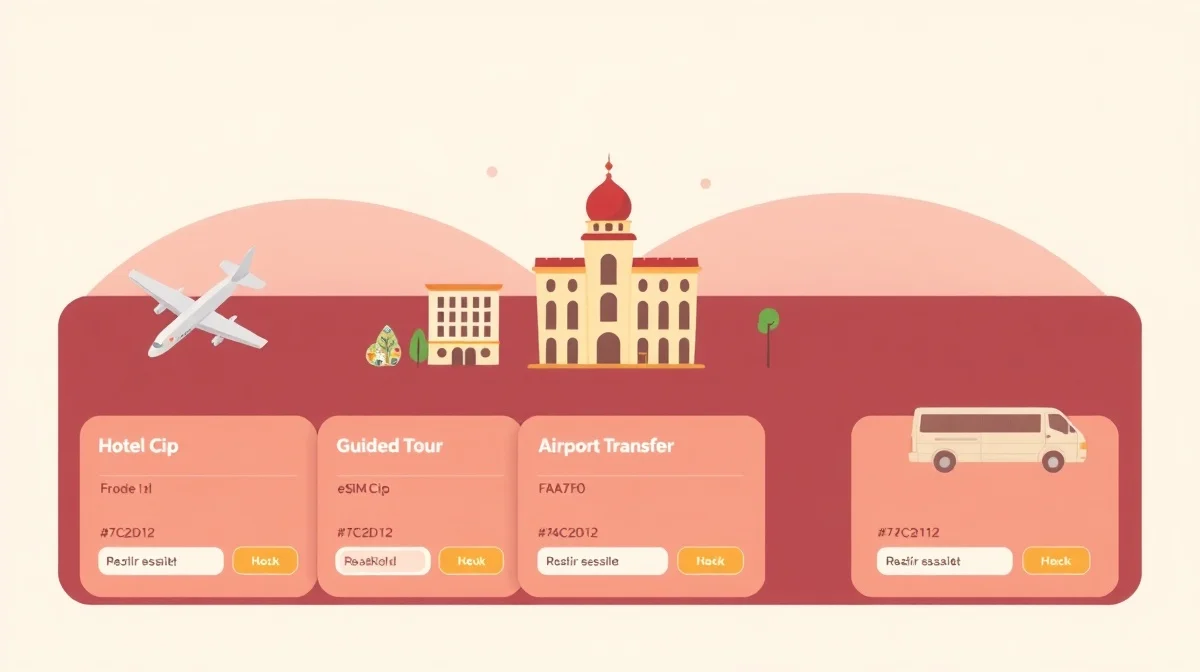 Every booking category — flights, hotels, eSIM, tours, transfers — has its own checkout and its own code rules
Layer 4 — freshness: how Travelpayouts partner feeds beat scrapers
Freshness is the one layer a scraper cannot fake, and it is our real edge. We pull codes from Travelpayouts partner feeds and the monthly Travelpayouts Telegram digests. These carry brand-issued codes with real expiry dates: Klook's PT24HIGO, Tiqets' SUMMERTP5, AirHelp's AHTPO9. Coupon sites list whatever they scrape from social feeds and email leaks. SimplyCodes' own figure: 40-60% of those are dead, restricted, or fake.
That gap is why a "tested, verified, and updated daily" badge is usually decoration. A real freshness signal is a date tied to one checkout test. Freshness also catches the timezone trap: "Is this promotion done? It's only July 19th here but says it's not valid." Promo windows often close at 23:59 UTC. A code can read dead while your clock still shows the last day. We check the brand's expiry against UTC. So we never mark a live code dead, or a dead one live. This dated check is how we verify travel codes without trusting a scraper's clock.
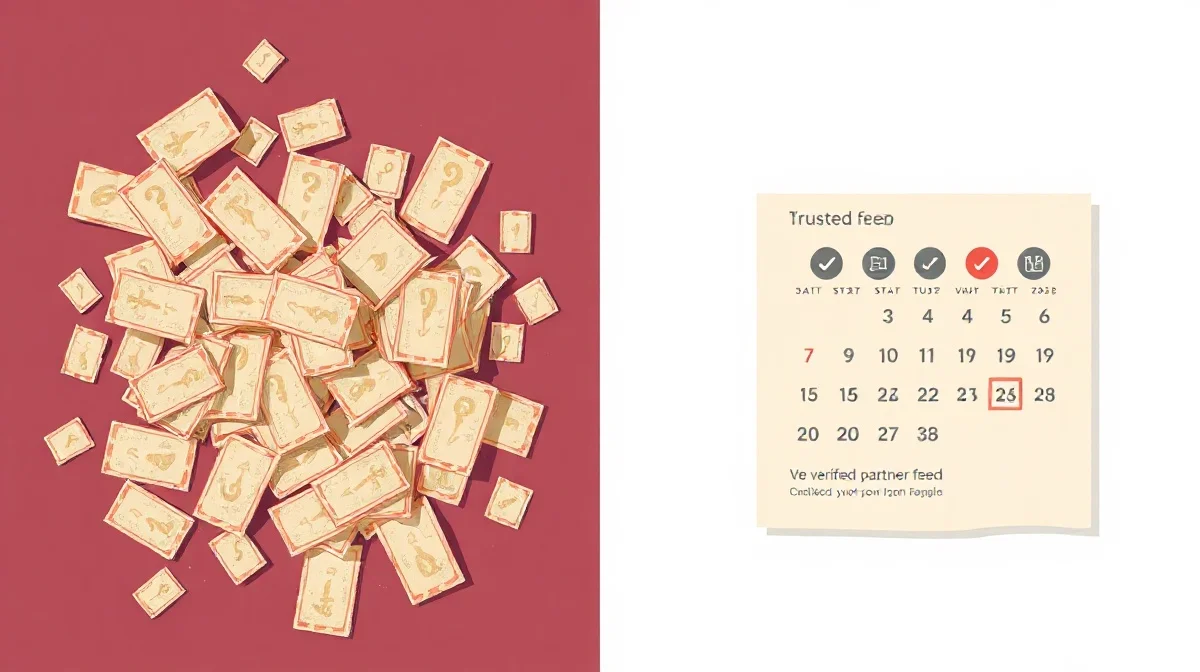 A scraped coupon pile versus a dated partner feed: freshness is the layer a scraper cannot fake
What a dated verification log entry looks like (worked example)
Every code we publish becomes one row: code, source, condition, date tested, verdict. Take Klook's PT24HIGO. It reaches us through the Travelpayouts Klook feed, not a scrape. The provenance chain is the point — you can trace each field back to where it came from.
Here is PT24HIGO across the four layers. Region: it applies on Klook activities in select Asia-Pacific places. Customer type: a first-booking rule, so we test a clean account and flag that older ones are out. Category: a tours code. We apply it at the Klook web checkout, where the promo field hides behind the price breakdown. Freshness: it comes from the feed with a brand-set window, so the expiry is Klook's own, and dated. The exact live discount sits on our Klook promo code page, because that number changes and this page does not.
| Code | Source (provenance) | Condition | Last tested | Verdict |
|---|---|---|---|---|
| PT24HIGO (Klook) | Travelpayouts Klook partner feed | First booking; select Asia-Pacific activities; web checkout | Jul 1, 2026 | Works (regional) |
| SBM50 | Viral social feeds — no partner match | Resolves to Amazon, not any travel brand | Jul 1, 2026 | Fake |
Testing note: a verifier applied each code at the brand's live checkout on July 1, 2026 from a US IP, on a new account where a first-order rule applied. We recheck this log monthly and stamp the date. It is not the rolling "today" placeholder that coupon sites auto-generate.
"When we ran PT24HIGO at Klook's web checkout on July 1, 2026, the promo field didn't even appear until we expanded the price breakdown — and it held the discount only on a clean account booking an Asia-Pacific activity, exactly as the feed's terms said." — GetTripCode Editorial Team
When we publish a 'Confident No' instead of a code
A Confident No is our verdict when no travel code works for your case: instead of a hopeful "up to 70% off," the page says "no working code right now" and points you to the levers that do save money — a member price, a currency switch, a partner link.
When no code works, we say so. That verdict is the product, not a gap. Booking through a Travelpayouts partner link earns this site a commission (affiliate marker 537469). The lazy move would be to list a hopeful "up to 70% off" and hope you click. We do the opposite. If a brand has no live code for your case, the page says "no working code right now." Then it points you to the levers that do save money. A returning Viator customer gets a member price and a currency-switch tip, not a phantom coupon.
The Confident No also handles viral fakes. Codes like SBM50 and GIMME10 turn up in the People-Also-Ask boxes of 30-plus brand searches. Every one fails at a travel checkout. We debunk them once in our fake code investigation, then link out to the real, dated codes instead. An honest "no" you can trust beats ten codes you have to test yourself.
FAQ
How often do you re-check a travel promo code?
Once a month, on a fixed cadence tied to the Travelpayouts partner digests. We also re-test off-cycle when a brand adds or expires a code. Every entry shows the date we last ran it at a live checkout, not a rolling "today" stamp. We last checked this method on July 1, 2026.
Do you earn money if I use a code from this page?
Yes, on some links. When you book through a Travelpayouts partner link (affiliate marker 537469), this site earns a commission at no extra cost to you. The commission never changes our verdict. A dead code still gets flagged dead, and a Confident No still ships.
Why do you list fewer codes than other coupon sites?
Because we only publish codes we tested. Big coupon sites scrape and list everything; SimplyCodes' own data puts 40-60% of public-web codes as dead, restricted, or fake. We check roughly 100-300 travel brands by hand instead of 622,000 by scraper, so most rows are verified, not guessed.
Sources
- SimplyCodes — the "40-60% of public-web codes are dead, restricted, or fake" figure and the ~622,000-store scraper scale come from SimplyCodes' own published data: simplycodes.com.
- Travelpayouts — the brand-issued codes we test (Klook's PT24HIGO, Tiqets' SUMMERTP5, AirHelp's AHTPO9) and their expiry dates come from Travelpayouts partner feeds and the official monthly Travelpayouts Telegram digests: travelpayouts.com.
- Our dated verification log — the roughly 100-300 hand-tested travel brands, live-checkout results, and verdicts are from our own manual checks, last run July 1, 2026: /how-we-verify/.
This site earns a Travelpayouts affiliate commission (marker 537469) when you book through our partner links, such as klook.com. It never changes your price or our verdict. We re-test codes monthly and date every entry.